Business Intelligence 101: What It Actually Means for Small Teams
If you hear “business intelligence” and picture a team of data scientists hunched over dashboards in a Fortune 500 office, you’re not alone. It’s one of those terms that sounds like it belongs to companies with entire departments dedicated to numbers — not a five-person team trying to figure out which marketing channel is actually working.
Here’s the good news: business intelligence isn’t a company size. It’s a habit.

So What Is Business Intelligence, Really?
Strip away the jargon and business intelligence (BI) is just this: turning the data your business already generates into decisions you can actually act on.
Every business — no matter how small — is already sitting on data. Sales numbers. Website visits. Email open rates. Customer support tickets. Inventory counts. BI is simply the practice of pulling that scattered information into one place, looking at it clearly, and using it to make better calls instead of guesses.
You don’t need a data warehouse or a six-figure software budget to do this. You need three things:
- A way to collect your data (which you probably already have — spreadsheets, your point-of-sale system, your CRM)
- A way to organize and visualize it (a dashboard, a report, even a well-built spreadsheet)
- A habit of actually looking at it before making decisions
That’s it. Everything else is just tooling on top of that basic idea.
Why Small Teams Skip It (and Why That’s a Mistake)
Most small businesses avoid BI for one of three reasons:
“We don’t have enough data to bother.” You have more than you think. Even a few months of sales and marketing numbers is enough to spot patterns — which products sell together, which days are slow, which channel actually brings in customers who stick around.
“It sounds expensive and technical.” This used to be true. BI tools were built for enterprise IT teams with dedicated budgets. That’s changed — there are now lightweight, affordable tools built specifically for small teams that don’t require a technical background to set up or read.
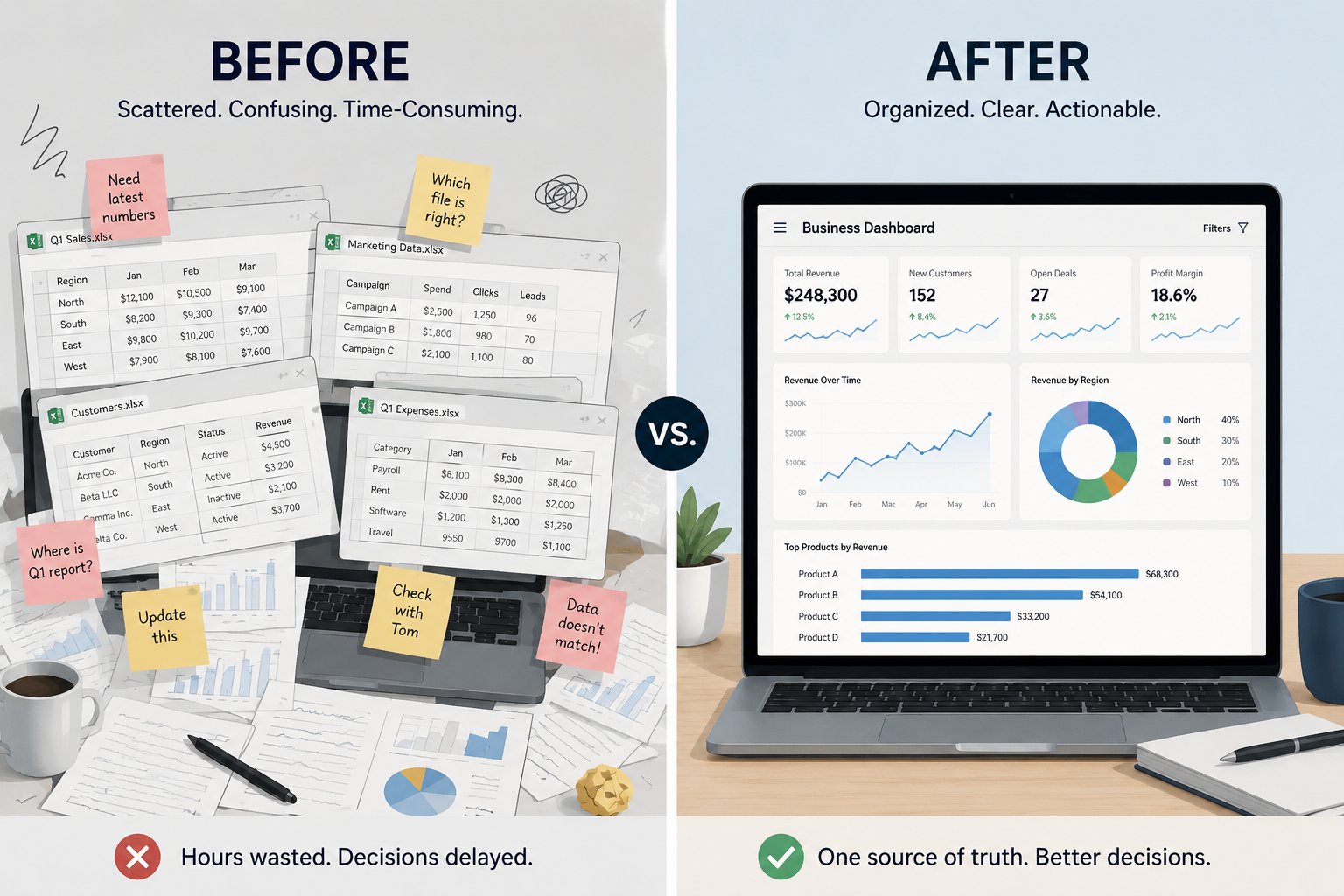
“We’re too busy running the business to analyze the business.” This is the real reason, and it’s understandable. But the irony is that a little bit of BI actually buys back time — instead of digging through three different systems every time you need an answer, you check one dashboard.
What BI Looks Like at Small-Team Scale
You don’t need to build what a large enterprise builds. A practical, small-team version of BI usually looks like:
- One dashboard, not ten. Pick your 4-6 most important numbers (revenue, new customers, churn, top product, website traffic, whatever matters to your business) and put them in one place you check weekly.
- A regular rhythm. Even 15 minutes every Monday morning looking at last week’s numbers beats an annual deep dive that happens once and gets forgotten.
- Answers to specific questions, not vanity metrics. “Which product line is actually profitable after returns?” matters more than “how many total sales did we have?”
- Tools that match your size. You don’t need enterprise software. You need something that connects to what you already use and doesn’t require a manual to operate.
Getting Started This Week
If you’re convinced but don’t know where to begin, start small:
- Pick one question you genuinely don’t know the answer to right now (e.g., “which of our products actually makes us the most profit?”)
- Find where that data already lives (probably your sales platform or bookkeeping software)
- Pull it into one simple view — a spreadsheet is fine to start
- Look at it. Make one decision based on what you see.
That’s your first real BI cycle. Everything after that is just repeating it and gradually making it easier to do.

The Bottom Line
Business intelligence isn’t about becoming a data company. It’s about not flying blind. Small teams that build even a modest habit of looking at their numbers regularly tend to make faster, more confident decisions — and catch problems (or opportunities) months before teams that are still guessing.
You don’t need a data department. You need one dashboard, one weekly habit, and the willingness to start.